



REVESCO. Revista de Estudios Cooperativos. ARTÍCULOS
e-ISSN: 1985-8031
Julieth Alzate
Universidad
Autónoma Latinoamericana (Colombia). Universidad EAFIT, School
of Management (Colombia) 

Diego René Gonzales-Miranda
Universidad
EAFIT, School of Management (Colombia)
https://dx.doi.org/10.5209/REVE.103424 Recibido: 09/12/2024 • Aceptado: 05/06/2025 • Publicado: 31/07/2025
ES Resumen. Este estudio profundiza en el estado liminal de la organización cooperativa. Como categoría proveniente de la antropología procesual, la liminalidad se utiliza para analizar los fenómenos identitarios en el campo de los estudios organizacionales. Esta revisión ha sido guiada por el propósito de proporcionar un panorama global de la literatura concerniente a la identidad cooperativa desde el enfoque de la identidad organizacional en estado liminal y sus fases. La revisión se realiza en dos grandes etapas: heurística y hermenéutica, las cuales se dividen en cinco momentos del protocolo de Denyer & Tranfield. Para la recolección y análisis de datos este trabajo se apoya en el uso de herramientas como la declaración PRISMA, Mendeley, ATLAS.ti y VOSviewer. Luego del análisis de la literatura, emergen cuatro grandes grupos de resultados: 1) una revisión de alcance presenta las teorías, métodos, geografías y problemas más abordados en la literatura, sugieren que la identidad cooperativa es un dispositivo para la preservación del sector, para la gobernanza y la transformación social; hasta su papel legalista y funcionalista para la eficiencia. 2) Las categorías comunes entre identidad liminal e identidad cooperativa, con base en las tres fases del estado liminal: separación, transición y agregación. 3) La brecha en la literatura y su relación con la dimensión interdisciplinaria de la identidad: filosofía, psicología, sociología, gestión, antropología. 4) Una consolidación de la agenda de investigación futura, destacando la identidad cooperativa en relación con las revoluciones tecnológicas y sociales contemporáneas, la agenda global, entre otras. Finalmente, los hallazgos apoyan la premisa del fenómeno liminal en las cooperativas y cómo éstas han experimentado un estado entrópico y liminal caracterizado por discrepancias, ambigüedad e indeterminación inherentes a la paradoja de la naturaleza dual de las organizaciones cooperativas y el contexto macroestructural actual. La literatura revisada reveló que otros autores se han interesado en estudiar fenómenos implícitamente relacionados con una fase de la liminalidad, es decir, con el proceso de transición entre la antigua y la nueva identidad cooperativa. En adición, algunas reivindicaciones de nuevas identidades cooperativas han movido el equilibrio financiero-social.
Palabras clave. Identidad cooperativa, identidad organizacional, identidad liminal, sector cooperativo, revisión sistemática de literatura.
Claves Econlit. B55, M10, M14, P13.
ENG Liminal identity in the cooperative organization:
A systematic literature review and future research agenda
ENG Abstract. This study delves into the liminal state of cooperative organization. As a category from processual anthropology, liminality is used to analyze the identity phenomena in the field of organizational studies. This review has been guided by the purpose of providing a global overview of the literature concerning cooperative identity from the approach of organizational identity in the liminal state and its phases. The review is conducted in two major stages: heuristic and hermeneutic, which are divided into five moments of Denyer & Tranfield's protocol. For data collection and analysis, this work is supported by the use of tools such as PRISMA statement, Mendeley, ATLAS.ti, and VOSviewer. After analyzing the literature, four broad groups of results emerge: 1) A scoping review presenting the theories, methods, geographies and problems most addressed in the literature, which suggest that cooperative identity is a device for preserving the sector, for governance and social transformation; up to its legalistic and functionalist role for efficiency. 2) The common categories between liminal identity and cooperative identity, based on the three phases of the liminal state: separation, transition, and aggregation. 3) The gap in the literature and its relationship with the interdisciplinary dimension of identity: philosophy, psychology, sociology, management, and anthropology. 4) A consolidation of the future research agenda, highlighting cooperative identity in relation to contemporary technological and social revolutions, the global agenda, among others. Finally, the findings support the premise of the liminal phenomenon in cooperatives and how that has experienced an entropic and liminal state characterized by discrepancies, ambiguity, and indeterminacy inherent in the paradox of the dual nature of cooperative organizations and the current macrostructural context. The reviewed literature revealed that other authors have been interested in studying phenomena implicitly related to one phase of liminality, that is, the process of transition between old and new cooperative identity. Then, some claims for new cooperative identities have shifted the financial–social balance.
Keywords. Cooperative identity, organizational identity, liminal identity, cooperative union, systematic literature review.
Summary. 1. Introduction. 2. Methodology. 3. Results and research gaps. 4. Discussion. 5. Conclusions. 6. References.
How to cite: Alzate, J. & Gonzales-Miranda, D.R. (2025). Liminal identity in the cooperative organization. A systematic literature review and future research agenda. REVESCO. Revista de Estudios Cooperativos, 150(1), 1-15, e103424. https://dx.doi.org/10.5209/REVE.103424.
“I do not know what or who I am.” The liminal state of identity is intricately embedded in this indeterminacy and may pose challenges for social economy organizations. The cooperative sector identity is clearly distinguished from others, especially because of its promise to address social problems in exercising its activity. This distinctiveness has sparked discussions about using the concept of social enterprise to reconcile the third sector's political, economic, and social ambiguities (Casey, 2016). In this sector, cooperatives emerge as one of the primary forms of organizations; they are recognized as autonomous associations of individuals who voluntarily come together to address common economic, social, and cultural needs and objectives through a jointly-owned and democratically controlled enterprise (International Cooperative Alliance [ICA], 1995).
Furthermore, the cooperative movement distinguishes itself from others by establishing a universal identity declaration. This identity declaration is structured within an axiological framework of principles and values that embody the social and solidarity-based nature of the sector—philanthropic attributes inherited from modernity in its commitment to social change (Vargas, 1995). These attributes form the backbone and defining characteristics of the model (Networks of networks of Alternative and Solidarity Economy, 2011). They also ensure the sector’s survival (Cracogna, 2019; Soler-Tormo, 2002) and assist public administrations in managing social welfare (Arnáez, 2018; Salamon & Toepler, 2015).
The genealogical development of this alternative model has upheld certain cooperative principles that persist within the current identity framework, established in 1995. This framework, a plausible compilation of the foundational and orthodox characteristics of the sector, consolidates an axiological matrix that each cooperative aligns with its social and operational endeavors. It is grounded in seven principles: voluntary and open membership, democratic member control, member economic participation, autonomy and independence, education, cooperation among cooperatives, and concern for the community. Additionally, the identity declaration of the cooperative movement emphasizes five fundamental values: mutual aid, responsibility, democracy, equality, equity, and solidarity (ICA, 1995).
Some changes in the world order have mobilized the International Cooperative Alliance (ICA) to call for the collective reconstruction of the sector's identity, making the identity change latent. In addition to this union disruption within the cooperative organization, individual organizations also experience internal changes that erode their identity—such as shifts in structure, social composition, management, economic activity, social purpose, and even corporate name.
As a result of these alterations, there reaches a point where the identity undergoes a state of transition—it is neither the old identity nor the new one. This phase is referred to as the liminal space, signifying a condition in which the fundamental questions raised by Albert and Whetten (1985) concerning organizational identity (OI)—namely, “Who are we as an organization?” and “What do they say we are as an organization?”—cannot be definitively answered. These seminal authors also define OI as the set of central, distinctive, and enduring elements that characterize an organization. While this definition has received academic recognition, there has been some discussion regarding its “enduring” aspect, notably since Gioia, Schultz, and Corley (2000) questioned it, and other authors (Gioia et al., 2013; Mathias et al., 2018) have put forth their own proposals.
In fact, the temporal dimension plays a pivotal role in contemplating liminal identity and organizational changes, as these unfold in the space–time continuum. Rooted in its theoretical foundations, liminality was conceptualized as a rite of passage by the seminal author van Gennep (1969). In his landmark work, The Rites of Passage, he described several change rituals occurring in individuals’ lives and social dynamics. Drawing on his perspective as a folklorist and ethnographer, he focused on transitory rituals, which accompany shifts in location, status, social standing, and age and are often performed during periods of upheaval and change.
As van Gennep posited (1969), rites of passage have three sequential phases: separation, transition, and reaggregation. Processual anthropologist Turner (1980) later embraced these categories to elucidate liminal processes, designating the transition phase as in-betweenness or liminality. Turner defines the liminal state of identity as a period of change that transpires between the separation and aggregation of a “new” identity.
The anthropological development of the liminal concept finds its parallel in the realm of organizations. Various authors, such as Chreim (2005), Gioia et al. (2013), Rao et al. (2003), and Ybema (2010), have delved into changes in OI and their drivers (separation phase). Others, including Clark et al. (2010), Corley et al. (2004), and Gonzales-Miranda (2016), have focused on studying transitions, discrepancies, and ambiguities in OI (liminal phase). Additionally, there are theorists who have investigated the processes of construction, formation, and negotiation–agreements in the field of OI (aggregative phase). These theorists include Alvesson et al. (2008), Ashforth et al. (2011), Clegg et al. (2007), Ellis and Ybema (2010), Gonzales-Miranda (2020b), and Hatch and Schultz (1997). Regardless of their nature, every organization experiences periods of indeterminacy during its life cycle.
In this context, cooperatives, as social organizations, undergo transformations in identity. Considering all the above, this study is motivated by the aim of providing an analytical approach to the literature. Particularly, it aims to examine how cooperative identity (CI) has been related to organizational identity in liminal state in the literature published between 1995 and 2023. The importance of this research lies in supporting the premise of the liminal state of CI, viewing it as a transitional moment where cooperatives’ social nature may be vulnerable. In essence, the implications of a state of indeterminacy and uncertainty influence behavioral orientations in organizations, as well as in the choices and actions taken.
Moreover, this systematic literature review (SLR) seeks to identify gaps in the existing body of knowledge and propose approaches to address them. In addition, it recognizes various contextual events and triggers of the liminal state of CI, along with their manifestations in each phase of identity transition. Finally, this study is intricately connected to the ICA’s current call for the reconstruction of the identity of the cooperative movement.
With these objectives in mind, this article is structured into five sections. First, this introduction offers some conceptual clarifications, as well as a synthesis of the research problem in conversation with the theorists and the main categories. The second section details the methodology and tools used to search and analyze the information. The third section presents the results in four subsections and suggests avenues for future research. The fourth section analyzes the results in light of the theory and describes certain limitations and strengths of this study. Finally, the fifth section concludes with the fulfilment of the research purposes and final reflections.
This review was divided into two broad phases: a heuristic phase and a hermeneutic phase. While the heuristic phase aims for consistency in data collection, the hermeneutic phase focuses on ensuring coherence in the interpretation and construction of results (Gómez et al., 2013). Additionally, we considered the methodological frameworks recommended for SLRs in the field of organizational studies, as proposed by Denyer and Tranfield (2009). Their proposal not only incorporates the principles of transparency and rigor but also outlines five sequential processes that underpin works based on documentary evidence.
2.1. Heuristic phase
Formulation of guiding questions for the systematic literature review
For the SLR, we centered our inquiry on the prevailing concepts of our research: cooperative identity, liminal identity, and organizational identity. Subsequently, the identified literature was mapped onto the phases of liminal identity through an analytical proposal that is part of the results. For the search, we used the following guiding question (Q1) and two complementary questions (C1 and C2):
Q1: How is cooperative identity related to organizational identity in a liminal state in the literature published between 1995 and 2023?
C1: What are the shared categories between cooperative identity and the phases of liminal identity?
C2: What are the main gaps in the literature that warrant consideration for future research?
The chosen time frame for the guiding question was determined by the issuance of the current cooperative identity declaration in 1995. Given the importance of this declaration in the long history of the cooperative movement and the need for its global dissemination, it is considered a significant milestone. It is worth noting that defining December 2023 as the end of the search period might constitute a limitation of this study.
Literature search
The articles were sourced from Web of Science and Scopus, two specialized databases widely acknowledged in the international academic community for their high quality and scientific contributions to the dynamics of knowledge. Additionally, another scientific database with a prominent focus on publishing content related to CI was included in the analysis. To select the most suitable one, the term cooperative identity was queried in the following platforms (with the number of results in parentheses): Redalyc (21), Scielo (4), Dialnet (44), DOAJ (13), and EBSCOhost (118). Considering the representativeness of its results, EBSCOhost was chosen as the third search platform.
Pilot searches were conducted, restricting the search to the articles’ metadata (i.e., title, abstract, and keywords). Furthermore, two families of concepts were defined concerning the two main categories under analysis: cooperative identity and organizational identity.
Table 1. Families of concepts
|
Organizational identity |
Cooperative identity |
|
“Organizational identity” “Liminal identity” “Liminal organizational identity” Identity |
“Cooperative identity” “Cooperative movement” Cooperative Co-operative Cooperativism |
Source: Prepared by the authors.
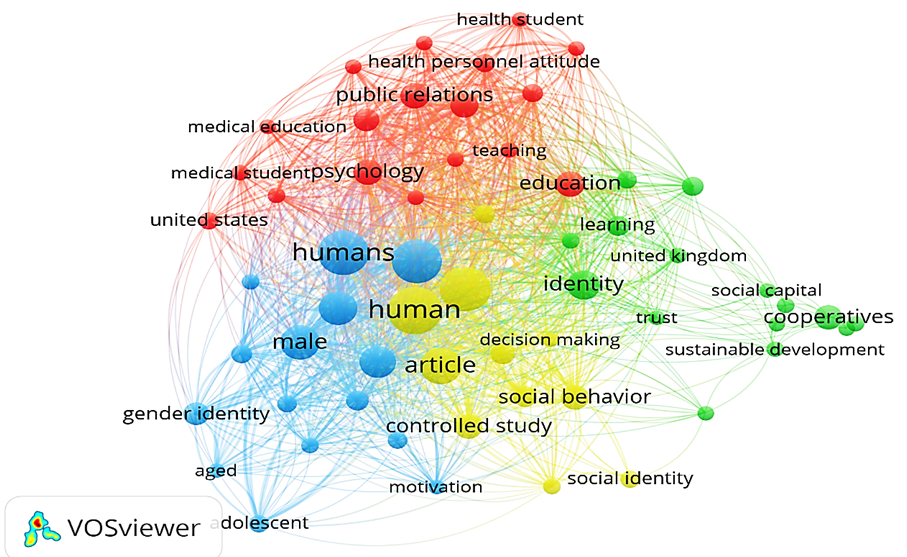
The database searches yielded 281 records, with dispersion in the results, revealing the loose use of the concept of identity. Despite narrowing the knowledge domains to social sciences, management, and economics, this noise persisted, which made data analysis less flexible because of the heterogeneity of the contents. A co-occurrence analysis of the results from these pilot searches (by families of concepts) was performed in VOSviewer (Fig 1). This analysis revealed a fragmentation of the various domains included in the search equation—psychology, medicine, anthropology, management, education, and sociology.
Fig 1. Thematic co-occurrence network
Source: Prepared by the authors using VOSviewer.
Considering this dispersion, word families were synthesized into the main categories to perform the search again. Finally, considering the parameterization of each database, the following four terms were considered: cooperative identity OR co-operative identity AND organizational identity OR liminal identity. Importantly, despite the unique parameterization of each database, efforts were made to ensure consistency in applying concepts, as well as the inclusion and exclusion criteria. Moreover, as indicated in the Preferred Reporting Items for Systematic Reviews and Meta-Analyses (PRISMA statement), the “others” option was added to include additional relevant literature. The final search produced the results presented in Table 2.
Table 2. Search equations and results per database
|
Database |
Query |
Results |
|
Web of Science |
"Cooperative identity" (Topic) or "co-operative identity" (Topic) and "organizational identity" (Topic) or "liminal identity" (Topic) and 2023 or 2022 or 2021 or 2020 or 2019 or 2018… or 1995 (Publication Years) |
49 |
|
Scopus |
Title-abs-key ( "cooperative identity" ) or title-abs-key ( co-operative and identity ) and title-abs-key ( organizational and identity ) or title-abs-key ( liminal and identity ) and pubyear > 1994 and pubyear < 2024 and ( limit-to ( doctype , "ar" ) ) and ( limit-to ( subjarea , "soci" ) or limit-to ( subjarea , "busi" ) or limit-to ( subjarea , "econ" ) ) and ( limit-to ( pubstage , "final" ) ) |
20 |
|
EBSCOhost |
(TI "cooperative identity" OR TI "co-operative identity" AND TI "organizational identity" OR TI "liminal identity") Note: Since EBSCOhost does not include a title, abstract, and keywords field, the title option was selected for the search. In addition, the following were other criteria not explicitly displayed in the query: 1995–2023, peer-reviewed publications, and online full-texts. |
31 |
|
Others |
Relevant documents found in other databases and recommended by experts. |
13 |
|
Total articles |
|
113 |
Source: Prepared by the authors.
To ensure meaningful and reasonably symmetrical results, the following exclusion criteria were applied for the search: 1) time frame limited to 1995–2023, 2) document type restricted to articles or peer-reviewed publications, 3) availability of final versions of articles online, knowledge domains restricted to social sciences, economics, business, and administration.
Regarding inclusion criteria, documents in the following languages were considered for the analysis: English, French, Spanish, and Portuguese, with a predominant emphasis on English texts.
Article selection and screening
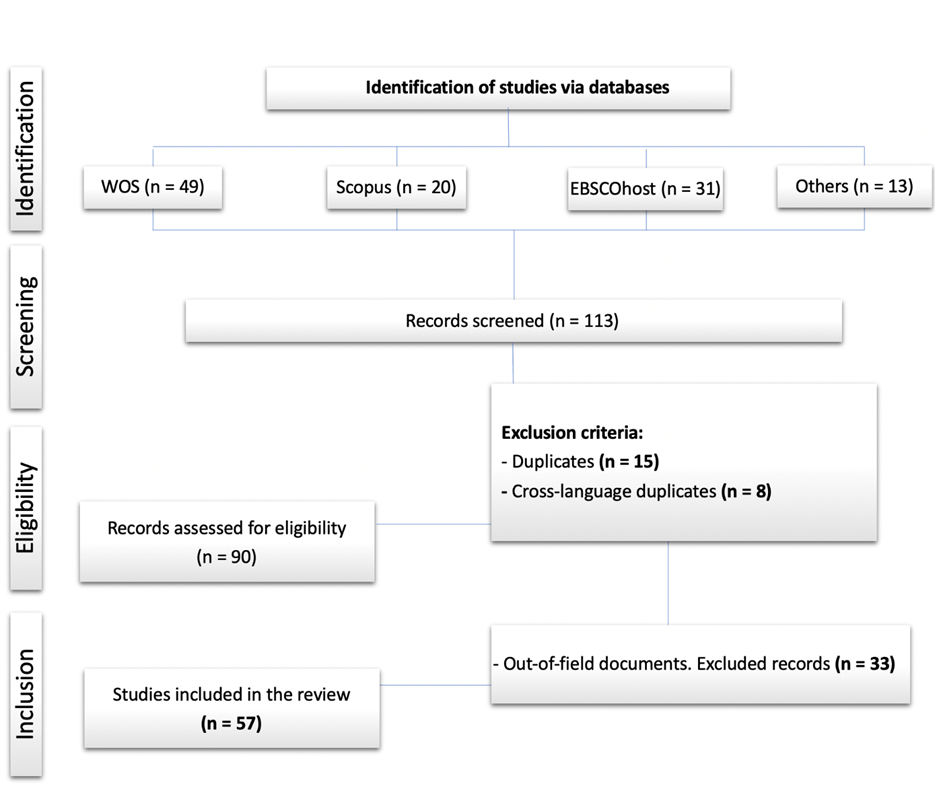
In this study, the four phases of the PRISMA statement (identification, screening, eligibility, and inclusion) were employed. Figure 2 offers a comprehensive overview of the additional criteria implemented during the article reading and review process.
Fig 2. PRISMA flow diagram for articles selection
Source: Prepared by the authors.
For the analysis of the liminal state of CI, the systematic nature of the applied methodology facilitated the selection of 57 publications containing valuable and enriching information. This abundance of information allowed us to arrive at the results discussed in the next section.
2.2. Hermeneutic phase
Content analysis and synthesis
Following the refinement process, the selected articles were exported to the reference management tool Mendeley. Each manuscript’s metadata underwent a thorough review, and an initial exploratory analysis was conducted. After the data from each article were processed, the consolidated files were imported into ATLAS.ti 22 for qualitative data analysis. This tool facilitated the systematic organization and coding of the information.
For the analysis, we used the taxonomy established by the coding, with the codes aligning with the categories of the theoretical contents. Furthermore, the distribution of citations found in the examined literature contributed to the analysis. The resulting findings are elaborated in full below.
The findings have been organized into three sections. Firstly, we provide a scoping review containing bibliometric information and trends in issues, theories, and methods in the field under analysis. Secondly, we present the findings relative to the guiding questions of the SLR. Thirdly, we address the knowledge gaps identified in the literature and suggest potential avenues for future research in the field.
3.1. Scoping review
In examining the trends within the reviewed manuscripts, we identified the following nine groups of research problems:
Table 3. Trends of the research problems
|
Research problems |
Authors |
|
Cooperative principles as legal platform for cooperative identity (CI) |
Conde & Rodríguez, 2020; Cracogna, 2018; Cracogna, 2019; Cracogna, 2021; de Miranda & Lima, 2020; Meira, 2021; Noble & Ross, 2021 |
|
Cooperative values, forming and guaranteeing the future preservation of CI |
Daussy & Karyotis, 2019; de Miranda, 2015; Macías, 2020 |
|
The social role of cooperatives lying in its CI, contributing to social transformation |
Alcântara et al., 2018; Arnáez, 2018; Conde & Rodríguez, 2020; Cracogna, 2021; Iyer et al., 2021; Grigorescu & Cruceru, 2013; Sánchez, 2022; Singh et al., 2021; Seiler & Bortnowska, 2023; Novkovic, 2021; van Rijn, 2022 |
|
Cooperative education in CI preservation |
Martínez, 2020; de Miranda & Lima, 2020; Etxeberria, 2020; Hetherington & Forrester, 2022; Noble & Ross, 2021; Singh et al., 2021 |
|
The relationship between CI and legislation |
Macías, 2022; Meira, 2021; Musa & Aguilar, 2018; Musa & Pacheco, 2021 |
|
The links between cooperative governance and CI |
Izquierdo, 2017; Hetherington & Forrester, 2022; Lang & Roessl, 2011; Michaud & Audebrand, 2022 |
|
Critique of the inconsistencies between CI and the operation of cooperatives |
Daussy & Karyotis, 2019; Michaud & Audebrand, 2022 |
|
CI as a functional object for competitiveness, income, and efficiency |
Boccatonda et al., 2019; Hatak et al., 2016 |
|
Training for CI consolidation and preservation |
Etxeberria, 2020; Charterina, 2020; de Miranda & Lima, 2020 |
Source: Prepared by the authors.
In terms of the employed methodologies, we observed a predominance of qualitative research, with a prevalence of legal–doctrinal and historical–legal methods, owing to the legalistic nature of CI (Burzaco Samper, 2021; Cracogna, 2021; García, 2020; Macías, 2022; Meira, 2021; Musa, 2013). Additionally, we identified a notable dominance of case studies (Alcântara et al., 2018; Errasti & Mendizabal, 2007; Hetherington & Forrester, 2022; Novkovic et al., 2022; Rousselière & Vézina, 2009; Singh et al., 2021). Variations of case study designs included a comparative analysis (Boccatonda et al., 2019), an ethnography (Huber & Brown, 2017), and grounded theory (Phua, 2004).
Importantly, theoretical studies are prioritized over empirical studies, with a prevalence of documentary and reflexive a priori research methods (Arnáez, 2018; Cracogna, 2021; de Miranda & Lima, 2020; Iyer et al., 2021; Michaud & Audebrand, 2022; Noble & Ross, 2021; Novkovic et al., 2022; Musa & Aguilar, 2018). Furthermore, authors were found to employ theories such as neo-institutional theory (Daussy & Karyotis, 2019), social order theory (Macías, 2022; Meira, 2021; Musa & Aguilar, 2018; Musa & Pacheco, 2021), governance theory (Michaud & Audebrand, 2022), and population ecology theory (Nelson et al., 2016).
As an additional insight from this descriptive mapping, we highlight the regions where the scientific community interested in CI concentrates, with the highest number of publications originating from Spain. Research efforts are particularly concentrated in the following four journals: (1) CIRIEC-España, Revista de Economía Pública, Social y Cooperativa; (2) Journal of Co-operative Organization and Management; (3) International Association of Cooperative Law Journal; and (4) Boletín de la Asociación Internacional de Derecho Cooperativo. Notably, leading authors in the field are situated in regions such as Spain, Canada, France, the United States, the United Kingdom, and India. In Latin America, Brazil and Argentina stand out in terms of publications in the field.
3.2. Commons categories between cooperative identity and liminal organizational identity
In both the pilots and final searches, we identified research that connected the study of CI with OI but not with the liminal phenomenon. This section proposes an association between these categories in response to complementary question C1. To achieve this, we conducted an analytical examination of the literature to determine which phase of liminality (separation, transition, or aggregation) aligns with the phenomena studied by researchers.
Separation
This phase of liminal identity is described as a turning point where a temporary state of indeterminacy is triggered. The catalyst for this disruption is societal changes that weaken identity (van Gennep, 1969; Turner, 1980; Gonzales-Miranda, 2020). In reviewing studies on CI, we found literature addressing disruptive changes with the potential to generate a moment of separation in CI.
As a first trigger, Uclés et al. (2016) emphasize the shift in people’s perception of cooperatives brought about by digitalization and social networks. These mass media are used transactionally rather than relationally, which means that, instead of serving a parallel function to foster social cohesion, they are employed for marketing purposes and as strategies to bolster the financial performance of cooperatives. This shift away from the social component has an impact on CI because it changes how the organization is perceived and places it in a financial and operational sphere distant from the principles and values of the sector.
As another disruptive event, the COVID-19 pandemic provides an opportunity for cooperatives to revert to a people-oriented identity (Iyer et al., 2021). According to de Miranda and Lima (2020), this global public health crisis serves as a warning to cooperatives about the danger of losing their CI. Alternatively, it is proposed to turn the gaze to the principle of education to safeguard CI in a post-pandemic scenario (Hetherington & Forrester, 2022; Charterina, 2020; Alcântara et al., 2018).
Other researchers also highlight a significant milestone triggered by neoliberal rationality and globalization (Errasti & Mendizabal, 2007; Vargas-Prieto, 2015). For instance, Wells et al. (2019) argue that neoliberal management has transformed the identity notion of community into a fiction. Likewise, there is a constant denouncement of neoliberal control over education and, consequently, over universities rooted in the cooperative model (Noble & Ross, 2021). Thus, in order to overcome neoliberal logics, it is imperative to once again promote CI (Hetherington & Forrester, 2022; Martínez Charterina, 2020; Noble & Ross, 2021).
All these events mentioned by the authors can be viewed as macrostructural turning points or occurrences external to the cooperative sector that end up permeating its dual nature and identity. Certainly, revolutions in mass media, pandemics, and the neoliberal economy can all lead to the separation or destabilization of CI, marking the beginning of a transitional phase towards the formation of a new identity.
Transition
This is the actual liminal state, representing a period of ambiguity and uncertainty, a time of indeterminacy regarding one’s identity. This transition involves the de-structuring and structuring of identity. It is a hazy, confusing time, full of contradictions and discrepancies (van Gennep, 1969; Turner, 1980; Gonzales-Miranda, 2020). When applying this concept to research on CI, a parallel phenomenon of indeterminacy is recognized: the paradox between a cooperative’s dual purpose as a social organization and a profit-oriented business (Novkovic et al., 2022), indicating an identity conflict brought on by the contradictory and hybrid goals of social organizations (Jäger & Schröer, 2014). In this context, Audebrand and Barros (2018) discuss the contradictions that arise in the exercise of this dual nature, which, Morales (2018) contends, will lead cooperatives to self-destruct as they lose their CI.
The ambiguous nature of CI is reflected in the poor application of cooperative principles (Rubio & Rivera, 2017), given the lack of clarity and disidentification with its essence. Members acknowledge the cooperative’s existence but lack a deep understanding of its identity (Atxabal, 2016; García, 2017). As a result, discrepancies arise between the cooperative’s guiding principles and how it operates (Musa & Pacheco, 2021), and, confronted with this contradiction, the cooperative may either adopt a borrowed identity or reify itself as a tool for competition and capital accumulation (Boccatonda et al., 2019; Daussy & Karyotis, 2019).
Aggregation
The identity in de-structuring state culminates in the aggregation of a new identity, distinct from the former (van Gennep, 1969; Turner, 1980; Gonzales-Miranda, 2020). In the realm of OI, this aggregation takes place after a process of socially constructing new, more homogeneous identity traits. According to research in cooperative settings, identity can be fabricated consensually (Rojas Herrera, 2022) and arbitrarily (Nelson et al., 2016; Wells et al., 2019), aiming, for instance, to promote cooperative attitudes among collaborators using psychological mechanisms to influence behavior (Phua, 2004).
Creating a new identity, however, is not a straightforward task, especially for the cooperative movement, which constantly strives to differentiate itself from other sectors. This intricate reconstruction is influenced by a number of variables, including sector-related and organizational factors, as well as the personal interests of leaders (Nelson et al. 2016). Power relations are indeed inherent in this process of identity construction, which, in certain cases, is deliberately configured to manage the organizational image and reputation, such as positioning the organization as a “sustainable cooperative” (Seramim et al., 2017). Strategies like humor for identity discipline (Huber & Brown, 2017) and training intervening in the organic process of collective construction (Etxeberria, 2020) have also been employed for the formation of CI. Another attribute that is used in identity construction is the culture of innovation. It serves as a tool to position the cooperative as an innovative organization and evoke identification from stakeholders through mimetic behaviors aligned with this modern purpose (Jacobs, 2013).
Furthermore, the concept of community has been used in constructing CI. Specifically, this concept is applied in institutional, administrative, and structural arrangements to shape a predetermined identity (Wells et al., 2019). Approached from a hybrid cooperative stance, Rojas (2022) suggests the potential of affinity between an organization and its members for identity fabrication in a soccer-sponsored cooperative. This affinity creates a social and emotional bond that permeates individuals’ perception of the organization. While various mechanisms are employed for diverse purposes, it is imperative to prioritize the reconstruction of CI following a natural process of change and evolution in cooperative organizations (Iglesias, 2020).
Considering the reviewed literature, this final phase underscores the existence of two concurrent phenomena: power and identity. The identity forged after a turbulent period is influenced by power dynamics, where the notion of community and collective identity construction may give way to an illusory discourse of neoliberal managerialism in modern cooperatives (Nelson et al., 2016; Seramim et al., 2017; Wells et al., 2019).
3.3. Research gaps
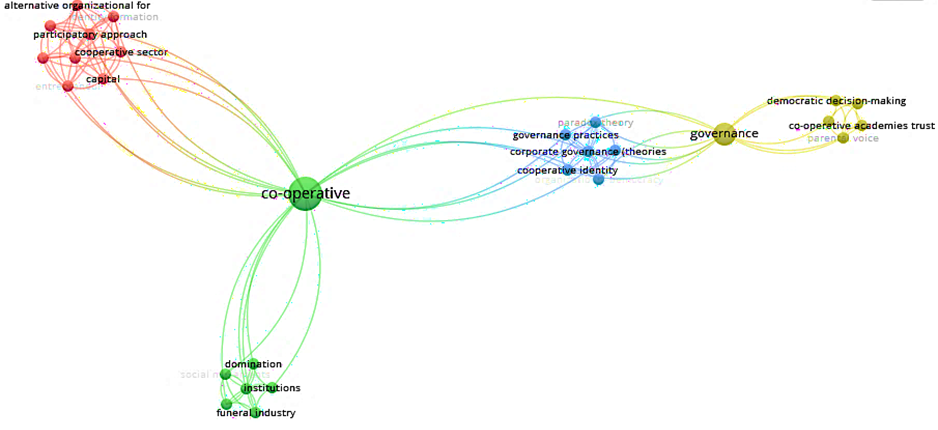
In addressing question C3 pertaining to research gaps, it should be noted that there is a scarcity of research on the interplay between CI and liminal identity. As detailed in earlier sections, the employed databases revealed a limited number of articles explicitly mentioning the liminality notion. This observation is reinforced by the outcomes of a co-occurrence analysis (Fig 3) that we conducted using the data retrieved from the databases and imported into VOSviewer.
Fig 3. Conceptual co-occurrence analysis
Source: Prepared by the authors.
The figure illustrates four major trends, presented as clusters. As observed, there is a dominant node (co-operative) around which research trends gravitate, encompassing topics such as alternative organizations, the cooperative sector, mutual organizations, cooperative identity, institutions, government practices, and governance. Nodes farther from the dominant one—those linked to collaborative learning and democratic decision-making—exhibited a weaker connection to the trend. Remarkably, no relationships were observed between liminal identity (despite its inclusion in the search equation) and the analyzed concepts, which underscores a gap in studying the relationship between CI and liminal identity.
Moreover, our examination of the literature revealed a vague and loosely applied use of the term identity in the field of cooperative studies. This suggests that, in the social imaginary, there exists a relatively uniform comprehension of the concept, even though these collective notions are not linked to validated theoretical developments. These inaccuracies in the literature encourage the association of numerous terms with the concept, including solidary identity, alternative identity, third-sector identity, and altruistic identity. In the backdrop, there is an understanding of the concept’s social nature, although it is often employed in the absence of well-established theoretical foundations.
In light of the aforementioned considerations, this study provides a novel framework to bridge the knowledge gap identified in the literature, employing a different approach to CI. Specifically, we embraced a theoretical standpoint of OI within the broader context of organizational studies. This perspective allows for a comprehensive examination of a particular subject, examined via an interdisciplinary lens that integrates anthropological, sociological, and organizational viewpoints. As a result, the concept of cooperative identity is endowed with a scientific dimension, complementing the social and functional characteristics attributed to it by the cooperative sector.
3.4. Future research agenda
This study makes a significant contribution to the field by outlining potential avenues for the exploration of CI. Drawing on the varied perspectives presented by the analyzed authors, we have identified four general categories of research problems—described below—that researchers engaging in the study of identity in social organizations may explore. Furthermore, we advocate for approaching these research agendas with a reflective, interpretative, and critical perspective to attain a thorough understanding of the reality of cooperatives.
Cooperative identity and contemporary revolutions
There is evidence that a new area of study is emerging, driven by the dynamics of the modern society. Authors such as Uclés et al. (2016), for instance, have studied the phenomenon of mass media, social networks, and new online communication models in the solidarity economy. However, our literature review revealed a paucity of research on CI in the context of contemporary revolutions, such as digitization, the information age, the fourth industrial revolution, blockchain, artificial intelligence, and other related topics.
Understanding how the digital era will impact CI and the preservation of the social and economic role of cooperatives is critical. Given the dominance of technological factors in the social order, the cooperative model must be continuously adopted and modified to ensure the viability of this alternative model for future generations.
Cooperative identity and social phenomena
Building on the preceding considerations, distinct social processes are unfolding alongside the accentuated technological revolution. Additionally, addressing humanistic aspects is imperative. While some authors have explored the social role of CI (Alcantara et al., 2018; Iyer et al., 2021; Singh et al., 2021; Arnáez, 2018; Conde & Rodríguez, 2020; Novkovic, 2021; van Rijn, 2022), future studies could concentrate on cultural factors influencing CI. For example, they could investigate how cultural and idiosyncratic differences impact CI across the globe.
Moreover, it is crucial to delve into CI in the context of diversity management and the incorporation of gender and racial dimensions within cooperatives. Particularly in the context of Colombia, studying CI for peacebuilding is pertinent, given that cooperatives currently serve as the associative structure facilitating peace initiatives in regions affected by armed conflict.
Cooperative identity and global agenda
In the wake of the 2030 agenda for achieving the sustainable development goals (SDGs), numerous authors have conducted studies linking SDGs to CI (Etxeberria, 2020; Grigorescu & Cruceru, 2013; Hernández, 2021; Pereira et al., 2018). Nonetheless, it is deemed appropriate to conduct further studies questioning the instrumentalization of the SDGs as a cosmetic and strategic resource used by organizations for marketing purposes. Given the inherently social and solidarity-based nature of cooperatives, their connection with the SDGs is undeniable. However, a more thoughtful approach to this interaction is necessary, along with sustainability considerations.
Among various issues involving government and multilateral entities, we propose exploring the link between CI and public policies for sustainability, the economic development of nations, and international dynamics such as globalization, the economy, international treaties, global peace, and human rights.
Cooperative identity and the individual
Apologetically, several authors have recognized the functional value of CI: for better organizational performance and image, for easier decision-making, and for increased efficiency, among other aspects (Boccatonda et al., 2019; Pereira et al., 2018; Rubio & Rivera, 2017; Uclés et al., 2016). Beyond these objectives, we propose an agenda wherein CI becomes an empowering mechanism that prioritizes individuals within the framework of an operational business. Thus, it is imperative that future studies examine CI from a power perspective, as well as the impact of organizational identity on individuals’ identity, behavior, and psychological well-being and on their perception of, identification with, and trust in the organization.
Based on these research perspectives concerning individuals, CI is not a neutral phenomenon without implications for those within the organization’s stakeholder groups. Conversely, it may turn out that this organizational identity significantly affects individuals’ behaviors and identity. There is still much to be explored regarding the positive or negative impacts of CI on its social foundations.
Given the multi-paradigmatic nature of knowledge, the outlined research agenda is presented in a manner that enables each academic community to approach it from its own ontological, epistemological, and methodological perspectives. Although CI is universal, it takes on different forms in different organizations; therefore, this proposal is flexible enough to accommodate the specific requirements, priorities, and unique circumstances of any research context. The previous research proposal can be summarized in Table 4.
Table 4. Summary of future research agenda
|
Cooperative identity – contemporary revolutions |
Cooperative identity – social phenomena |
Cooperative identity – global agenda |
Cooperative identity – individuals |
|
· Fourth and fifth industrial revolution. · Age of information. · Digitization. · Artificial intelligence. |
· World cultures and idiosyncrasies in the CI. · Diversity. · Gender inclusion. · Racial inclusion. · CI and peace building. |
· SDGs. · Sustainability. · Climate change. · Public policy. |
· Emancipation. · Domination. · Psychological well-being or discomfort. · Identification. · Trust in cooperatives. |
Source: Prepared by the authors.
Importantly, some of the topics proposed for future studies have already been addressed. However, given the dynamic nature of reality, approaching them from geographical and temporal contexts not yet addressed is relevant.
Analyzing the literature on CI through the lens of the liminal identity theory has brought to light several threats that undermine it and divert it from its social mission. The literature emphasizes that, in certain cases, the social aspect has taken a backseat to financial considerations. Hence, the emphasis on the current liminal state of CI. Although not always explicitly stated, the literature examines phenomena related to the phases of the liminal state—whether by identifying events that trigger its indeterminate condition (separation), addressing its ambiguity and internal crises (transition), or illustrating collective efforts toward restructuring and identity reconstruction (aggregation).
In addition to the three phases of the liminal state, processual anthropologists suggest that liminality is a construction process that transitions from an old identity to a new identity. The literature clearly reflects both the old identity and the ongoing or completed processes of change. This raises the question about the safe arrival of the sector to a new cooperative identity. Although some authors reaffirm a new identity, it is important to see organizational identity as a dynamic phenomenon, in which new ports and new horizons of cooperative identity are constantly emerging. Each port implies new behaviors and decisions of the sector and of the organizations in response to these new identities. Additionally, the question about the validity of the social quality in these new identities of the sector is pertinent.
According to the literature, the pecuniary logic has dominated in the paradox of social enterprise versus rent-seeking enterprise, especially when the generated surpluses fail to circulate back to the social base, compromising the organizations’ non-profit status. This situation has fostered an atmosphere of uncertainty within the cooperative movement, driven by the discrepancies between labels and conflicting meanings associated with CI. As regards the social promise of the third sector, there is a clear lack of precision in contemporary times. Therefore, it is imperative that there be a renewed discussion at the sector and academic levels to preserve its dual nature and ensure the balance between the financial and social dimensions.
These findings carry implications for both the union and the scientific field. For the sector, they underscore the importance and necessity of reconstructing the identity declaration of the cooperative movement. Indeed, this study supports the ICA’s initiative to launch an international survey and facilitate both open and closed discussions within the sector. The aim is to define an identity that aligns with the contemporary reality of cooperatives.
For the sector, the exploration of the liminal space opens up a fresh avenue of study within cooperative organizations. It encourages continuous reflection and a focus on the social attributes inherent to the sector. Furthermore, the OI theory paves the way for new pivotal questions within the sector, such as: “What is our current status as a sector?” “How is our sector perceived?” “In the contemporary landscape, what are the central, continuous, and distinctive features of the third sector and each associative form within it?” As the dynamics of identity are constantly evolving, these questions remain pertinent today. In addition to the research agenda proposed earlier, the scientific community is still confronted with unanswered questions.
Likewise, our review identified other academic communities and geographical regions that could foster collaborations and enrich the discussion surrounding the sector’s identity and organizational typologies. This also includes contributions regarding its relationship with the prevailing technological, economic, and social revolutions.
As an SLR, this study has certain limitations. Firstly, certain documents were excluded based on a set of initial search criteria, encompassing temporal restrictions, document type (final articles published in peer-reviewed scientific journals), search fields for keywords and the proposed families of concepts, as well as language limitations. Following this, inclusion and exclusion criteria were also applied to refine the search using the PRISMA statement. While each criterion has been justified and aimed to facilitate a systematic and rigorous analysis, it inevitably led to the exclusion of relevant literature. In accordance with the latest version of the PRISMA statement, the “others” option was also included to incorporate additional relevant literature into the analysis that goes beyond the exclusion criteria.
Furthermore, despite the reliability of the employed databases and the peer-reviewed nature of the journals under analysis, it would be inaccurate to assert that the entire body of literature being studied is of a high caliber. Another inherent limitation in qualitative and hermeneutic studies is the potential for bias in interpretation. In this context, the section delving into the shared categories between CI and OI is considered as particularly vulnerable. To mitigate this bias, a taxonomy was created, aiming not to be exhaustive but rather suggestive in relation to studies that may not explicitly address liminality but are situated within one of its phases. This stands as one of the most significant contributions of this study.
As for the main contributions, this SLR aimed to make advancements in four key areas. Firstly, a scoping review was conducted to map out the problems, methodologies, theories, domains, audiences, and prevailing geographies in the field. Secondly, it established a connection between the literature and the categories associated with organizational identity in a liminal state. Thirdly, it addressed gaps in the study of liminality, distorted interpretations of CI, and the interdisciplinary nature of identity studies. Lastly, it laid out an agenda for future research, divided into four areas inspired by the assertions found in the analyzed works and our own observations.
To address a gap identified in the existing literature, this study proposes a relational analysis—as a novel contribution—to deepen our understanding of CI through the key categories and phases of liminal identity, which we consider sufficiently addressed. It sheds light on how research on CI has portrayed numerous manifestations of an identity state characterized by indeterminacy and ambiguity. Particularly noteworthy is the authors’ inclination to delve into issues compromising the altruistic attributes of CI, along with the various paradoxes and contradictions that cooperative organizations have faced throughout their historical evolution. These insights serve as a warning about the structural changes that the cooperative movement is currently undergoing due to the macrostructural pressures of the new world order.
In this context, this study aligns with the ICA’s efforts to globally shape a new identity declaration, emphasizing the sector’s responsibility in safeguarding its dual function while keeping pace with modern dynamics. Undoubtedly, the ICA’s initiatives and recent studies on CI make substantial contributions to this noble cause, serving to ensure the continuity of the sector over time.
Finally, drawing on the varied perspectives presented by the analyzed authors, we were able to develop a proposal for future research, often centering around understanding the impact of various contemporary phenomena on third-sector organizations. Posing questions about the current landscape is always pertinent, as every passing moment unfolds a new reality worthy of exploration.
The authors declare no conflict of interest.
Conceptualization, J.A. and D.R. G.-M.; methodology, J.A. and D.R. G.-M.; software, J.A.; validation, J.A. and D.R. G.-M.; formal analysis, J.A. and D.R. G.-M.; investigation, J.A. and D.R. G.-M.; resources, J.A. and D.R. G.-M.; data curation, J.A. and D.R. G.-M.; writing—original draft preparation, J.A. and D.R. G.-M.; writing—review and editing, J.A. and D.R. G.-M.; visualization, J.A.; supervision, D.R. G.-M.; project administration, J.A. and D.R. G.-M. All authors have read and approved the published version of the manuscript.
This research has been financially supported by the Universidad Autónoma Latinoamericana and EAFIT University, for the doctoral project "(Re)Construction of Liminal Organizational Identity. A Study from the Cooperative Organization."
Albert, S., & Whetten, D. (1985). Organizational identity. Research in Organizational Behavior, 7, 263–295.
Alcântara, L. C. S., Sampaio, C. A. C., & Zabala, L. U. (2018). Mondragon Cooperative Experience: Education cooperative as a process of social transformation. CIRIEC-Espana Revista de Economia Publica, Social y Cooperativa, 93, 181–209.
Alvesson, M., Ashcraft, K. L., & Thomas, R. (2008). Identity matters: Reflections on the construction of identity scholarship in organization studies. Organization, 15(1), 5–27.
Arnáez, V. M. (2018). The cooperative alternative in the provision of sustainable public services. Boletin de la Asociacion Internacional de Derecho Cooperativo, 52, 123–135.
Ashforth, B. E., Rogers, K. M., & Corley, K. G. (2011). Identity in organizations: Exploring cross-level dynamics. Organization Science, 22(5), 1144–1156.
Atxabal, A. (2016). La identidad cooperativa como justificación de un tratamiento fiscal diferenciado. International Association of Cooperative Law Journal / Boletín de la Asociación Internacional de Derecho Cooperativo, 50, 285–307.
Audebrand, L. K., & Barros, M. (2018). All Equal in Death? Fighting inequality in the contemporary funeral industry. Organization Studies, 39(9), 1323–1343.
Boccatonda, C., Banchieri, L.C., & Campa-Planas, F. (2019). Key factors of a cooperative central purchasing office. Comparative analysis of two experiences. CIRIEC-Espana Revista de Economia Publica, Social y Cooperativa, 96, 91–119.
Burzaco, M. (2021). Public intervention in cooperatives: the need to review the “administrative tutelage” model. CIRIEC-Espana, Revista Jurídica de Economia Social y Cooperativa, 2021(39), 97–134.
Casey, J. (2016). The Nonprofit World: Civil Society and the Rise of the Nonprofit Sector. Kumarian Press.
Chreim, S. (2005). The continuity-change duality in narrative texts of organizational identity. Journal of Management Studies, 42(3), 567–593.
Clark, S. M., Gioia, D. A., Ketchen, D. J., & Thomas, J. B. (2010). Transitional identity as a facilitator of organizational identity change during a merger. Administrative Science Quarterly, 55(3), 397–438.
Clegg, S. R., Rhodes, C., & Kornberger, M. (2007). Desperately seeking legitimacy: Organizational identity and emerging industries. Organization Studies, 28(4), 495–513.
Conde, M. A. A., & Rodríguez, J. F. A. (2020). The social balance and the relations between the sustainable development goals and the cooperative principles for Colombia under a social network analysis. CIRIEC-Espana Revista de Economia Publica, Social y Cooperativa, 99, 57–87.
Corley, K. G., & Gioia, D. A. (2004). Identity ambiguity and change in the wake of a corporate spin-off. Administrative Science Quarterly, 49(2), 173–208.
Cracogna, D. (2018). The economic and legal impact of the third principle of the International Cooperative Alliance. International Association of Cooperativa Law Journal, 53, 21–36.
Cracogna, D. (2019). The principle of autonomy and independence in the declaration on cooperative identity. Boletin de La Asociacion Internacional de Derecho Cooperativo, 55, 19–34.
Cracogna, D. (2021). Cooperation among cooperatives: Principle or need? . Boletin de la Asociacion Internacional de Derecho Cooperativo, 59, 75–87.
Daussy, C., & Karyotis, C. (2019). Valeurs coopératives des banques et RSE : un changement de paradigme durable ? Cooperative Banks Values and CSR: A Lasting Change of Paradigm?, 134, 193–204.
De Miranda, J.E., & Lima, A. C. (2020). The influence of the principle of education, training and information on cooperative identity: From the practical consequences of the merely formal application towards the preservation of the essence of cooperativism in the post-pandemic scenario. Boletin de la Asociacion Internacional de Derecho Cooperativo, 57, 95–111.
De Miranda, J. E. (2015). El sistema de crédito cooperativo brasileño y la identidad cooperativa: la necesidad de vigilancia permanente de los valores del cooperativismo para la sostenibilidad del modelo. Boletín de la Asociación Internacional de Derecho Cooperativo, 49, 65–82.
Denyer, D., & Tranfield, D. (2009). Producing a systematic review. In D. A. Buchanan & A. Bryman (Eds.), The Sage handbook of organizational research methods (671–689). SAGE Publications Ltd.
Ellis, N., & Ybema, S. (2010). Marketing identities: Shifting circles of identification in inter-organizational relationships. In Organization Studies (Vol. 31, Issue 3). 279-305.
Errasti, A., & Mendizabal, A. (2007). The impact of globalisation and relocation strategies in large cooperatives: the case of the mondragon cooperative fagor electrodomesticos s. coop. In S. Novkovic & V. Sena (Eds.), Cooperative firms in global markets (Vol. 10, 265–295).
Etxeberria, G. M. (2020). The strengthening of cooperative identity through training: An element to be considered by the cooperative movement. Boletin de la Asociacion Internacional de Derecho Cooperativo, 57, 171–205.
García, M. (2020). Union rights and freedom of union in worker cooperatives. Commentary to the Supreme Court (Social Chamber) Judgment of May 8, 2019. Roj: 1944/2019. CIRIEC-Espana, Revista Jurídica de Economia Social y Cooperativa, 2020(36), 423–443.
García, C. I. (2017). Comunicación de la Identidad Cooperativa centrada en la Responsabilidad Social. Más allá de la publicidad comercial. Chasqui, 134, 107–126.
Gioia, D. A., Patvardhan, S. D., Hamilton, A. L., & Corley, K. G. (2013). Organizational identity formation and change. The Academy of Management Annals, 7(1), 123–193.
Gioia, D. A., Schultz, M., & Corley, K. G. (2000). Organizational Identity, Image, and Adaptive Instability. The academy of management review, 25(1), 63–81.
Gómez, M., Galeano, C., & Jaramillo, D. (2013). El Estado Del Arte: Una Metodología De Investigación the State of the Art: a Research Methodology. Revista Colombiana de Ciencias Sociales, 6(2), 423–442.
Gonzales-Miranda, D. R. (2016). Identidad organizacional de los mandos medios en equilibrio liminal. Revista Venezolana de Gerencia, 21(75).
Gonzales-Miranda, D. R. (2020a). Identidad Organizacional. Un proceso de construcción liminal. Editorial EAFIT.
Gonzales-Miranda, D. R. (2020b). Organizational identity: Components and construction. Innovar, 30(78), 89–103.
Grigorescu, S., & Cruceru, D. (2013). Democratic Participation in the Model for Emphasis and Protection of Cooperative Identity and Social-Economic Activity of the Society. Romanian Statistical Review, Sup, 13–21.
Hatak, I., Lang, R., & Roessl, D. (2016). Trust, social capital, and the coordination of relationships between the members of cooperatives: A comparison between member-focused cooperatives and third-party-focused cooperatives. Voluntas, 27(3), 1218–1241.
Hatch, M. J., & Schultz, M. (1997). Relations between organizational culture, identity and image. European Journal of Marketing, 356–365.
Hernández Cáceres, D. (2021). Origen y desarrollo del principio cooperativo de interés por la comunidad. REVESCO. Revista de Estudios Cooperativos, vol. 139, e76634. https://dx.doi.org/10.5209/reve.76634.
Hetherington, J. E., & Forrester, G. (2022). Values-led governance and parental and community engagement in the Co-operative Academies Trust: An alternative in the neoliberal context of education? Management in Education, 36(1), 34–41.
Huber, G., & Brown, A. D. (2017). Identity Work, Humour and Disciplinary Power. Organization Studies, 38(8), 1107–1126.
Iglesias, S. (2020). Cooperative Cooperation: Being, Doing, and Becoming. Cooperação Cooperativa: O Ser, o Fazer e o Devir., 24(6), 567–581.
International Cooperative Alliance, 1995, Cooperative identity, values & principles | ICA. https://ica.coop/en/cooperatives/cooperative-identity.
Iyer, B., Gopal, G., Dave, M., & Singh, S. (2021). Centering cooperatives and cooperative identity within the social and solidarity economy: Views from the Asia-Pacific cooperative apexes and federations. Journal of Co-Operative Organization and Management, 9(2). 100-145.
Izquierdo, M. E. (2017). La adhesión voluntaria e identidad cooperativa en las empresas cooperativas mexicanas. Boletín de la Asociación Internacional de Derecho Cooperativo, 51, 21–44.
Jacobs, H. (2013). Co-innovation through multiple social identity processes: The story of a South African co-op owned business. European Business Review, 25(1), 42–64.
Jäger, U. P., & Schröer, A. (2014). Integrated Organizational Identity: A Definition of Hybrid Organizations and a Research Agenda. Voluntas, 25(5), 1281–1306.
Lang, R., & Roessl, D. (2011). Contextualizing the Governance of Community Co-operatives: Evidence from Austria and Germany. Voluntas, 22(4), 706–730.
Macías Ruano, A.J. (2022). La igualdad como valor cooperativo y su proyección en la legislación cooperativa. REVESCO. Revista de Estudios Cooperativos, vol. 141, e82258. https://dx.doi.org/10.5209/REVE.82258.
Martínez, A. (2020). The cooperative principle of education, training and information from a historical and doctrinal perspective. Boletin de la Asociacion Internacional de Derecho Cooperativo, 57, 133–145.
Mathias, B. D., Huyghe, A., Frid, C. J., & Galloway, T. L. (2018). An identity perspective on coopetition in the craft beer industry. Strategic Management Journal, 39(12), 3086-3115.
Meira, D. (2021). Cooperative economic groups at the crossroads between the principles of cooperation among cooperatives and autonomy and independence. An analysis under the Portuguese Law. International Association of Cooperativa Law Journal, 59, 149–181.
Michaud, M., & Audebrand, L. K. (2022). One governance theory to rule them all? The case for a paradoxical approach to co-operative governance. Journal of Co-Operative Organization and Management, 10(1). 100-151.
Morales, R. C. (2018). The self-destructive path of the Puerto Rican housing cooperativism: the problem of the loss of the cooperative identity through the transformation of use values into exchange values. International Association of Cooperativa Law Journal, 52, 19–46.
Musa, O.R., & Aguilar, O. H. (2018). Reflections about the juridical implementation of the principle of «the members’ economic participation» in the Cuban cooperatives. Boletin de la Asociacion Internacional de Derecho Cooperativo, 52, 107–122.
Musa, O R, & Pacheco, D. F. (2021). The Constitutional Regulation of Cooperative Social Responsibility. Critical Notes For Cuba. Prisma Social, 35, 117-140.
Musa, O.R. (2013). The cooperative identity in the cuban constitution. Currents challenges. In Cooperativismo y Desarrollo. 1(2), 122–133.
Nelson, T., Nelson, D., Huybrechts, B., Dufays, F., O’Shea, N., & Trasciani, G. (2016). Emergent identity formation and the co-operative: theory building in relation to alternative organizational forms. Entrepreneurship and Regional Development, 28(3–4), 286–309.
Network of Economy and Solidarity Alternative Networks (2011). Charter of Principles of the Solidarity Economy. 1–13. https://reas.red/carta-de-economia-solidaria/.
Noble, M., & Ross, C. (2021). From principles to participation: “The Statement on the Cooperative Identity” and Higher Education Co-operatives. Journal of Co-Operative Organization and Management, 9(2). 1-9.
Novkovic, S. (2021). Cooperative identity as a yardstick for transformative change. Annals of Public and Cooperative Economics. 93(2). 313-336.
Novkovic, S., Puusa, A., & Miner, K. (2022). Co-operative identity and the dual nature: From paradox to complementarities. Journal of Co-Operative Organization and Management, 10(1), 100162.
Pereira, M. de L., Lucena, W. G. L., & Paiva, S. B. (2018). A Sustentabilidade e Gestão da Imagem: Um Estudo de Caso em Cooperativa Agroindustrial do Oeste do Paraná. Revista de Gestão Ambiental e Sustentabilidade – GeAS, 7(2), 300–321.
Phua, F. T. (2004). The antecedents of co-operative behaviour among project team members: An alternative perspective on an old issue. Construction Management and Economics, 22(10), 1033–1045.
Rao, H., Monin, P., & Durand, R. (2003). Institutional change in toque ville: Nouvelle cuisine as an identity movement in French gastronomy. American Journal of Sociology, 108(4), 795-843+i.
Rojas Herrera, J.J. (2022). Cooperativismo y futbol: ¿Identidades compartidas o disímiles en la cooperativa de productores de cementos portland La Cruz Azul?. REVESCO. Revista de Estudios Cooperativos, vol. 141, e82256. https://dx.doi.org/10.5209/REVE.82256.
Rousselière, D., & Vézina, M. (2009). Constructing the legitimacy of a financial cooperative in the cultural sector: A case study using textual analysis. International Review of Sociology, 19(2), 241–261.
Rubio, G. A., & Rivera, M. Á. (2017). Una mirada a las organizaciones del sector cooperativo desde la aplicación de sus principios. caso Ibagué (Colombia). 9(1), 112–125.
Salamon, L. M., & Toepler, S. (2015). Government–Nonprofit Cooperation: Anomaly or Necessity? Voluntas, 26(6), 2155–2177.
Sánchez, L. R. (2022). Recognition of the existence of the Principle Concert for Community in the Declaration of Cooperative Identity, the case of Costa Rica. Boletin de La Asociacion Internacional de Derecho Cooperativo, 61, 57–77.
Seiler, B., & Bortnowska, H. (2023). Expressing identity in mission statements: a case of Polish social cooperatives. CIRIEC-Espana Revista de Economia Publica, Social y Cooperativa, 107, 127–167.
Seramim, R. J., Zanella, T. P., & Rojo, C. A. (2017). A sustentabilidade e gestão da imagem: um estudo de caso em cooperativa agroindustrial do oeste do Paraná. Sustainability and Image Management: A Case Study in Agroindustrial Cooperative of Western Paraná., 6(3), 15–33.
Singh, S., Holvoet, N., & Dewachter, S. (2021). A Relational Understanding of Co-Educating and Learning: Information Sharing and Advice Seeking Behavior in a Dairy Cooperative in Gujarat, India. Journal of co-operative organization and management, 9(2). 100-150.
Soler-Tormo, F. V. (2002). La identidad cooperativa como garantía de futuro : las cooperativas de crédito ante la trivialización de sus principios. CIRIEC-España, Revista de Economía Púbica, Social y Cooperativa, Abril(040), 215–242.
Turner, V. (1980). La selva de los símbolos. Madrid: Siglo XXI.
Uclés, D. F., Moral, A. M., Jurado, E. B., & Viruel, M. J. M. (2016). Use and efficiency of social media. An analysis from the social economy. CIRIEC-Espana Revista de Economia Publica, Social y Cooperativa, 88(1), 5–27.
Van Gennep, A. (1969). Los ritos de paso. Madrid: Alianza Editorial S.A.
Van Rijn, J. (2022). The cooperative identity at U.S. credit unions. Journal of Co-Operative Organization and Management, 10(1). 100-152.
Vargas, A. (1995). La identidad cooperativa y la cooperativa como empresa: luces y sombras. REVESCO. Revista de Estudios Cooperativos, 61. 179-194.
Vargas, A. (2015). La identidad cooperativa en el contexto de la globalización. Economía y Desarrollo, 155(2), 101–118.
Wells, V., Ellis, N., Slack, R., & Moufahim, M. (2019). It’s Us, You Know, There’s a Feeling of Community: Exploring Notions of Community in a Consumer Co-operative. Journal of Business Ethics, 158(3), 617–635.
Ybema, S. (2010). Talk of change: Temporal contrasts and collective identities. Organization Studies, 31(4), 481–503.